Methods of Communication
 0
0
 0
0
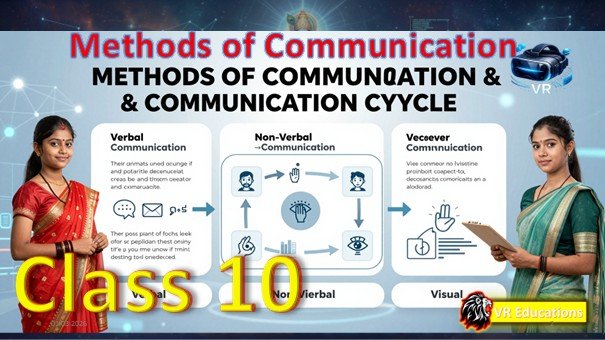
Methods of Communication
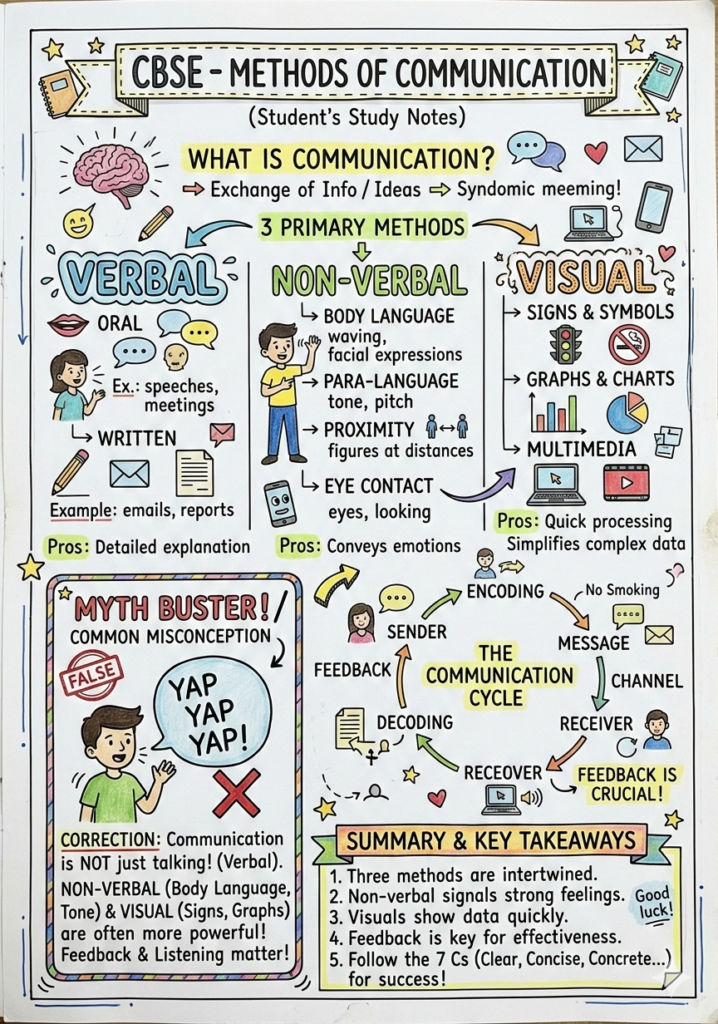
In the CBSE curriculum (typically covered in Information Technology or English Communicative subjects), Methods of Communication refers to the various ways humans exchange information. Understanding these is key to mastering “Communication Skills,” which is the first unit in many vocational courses.
Communication is generally categorized into three primary methods:
1. Verbal Communication
This is the use of sounds and language to relay a message. It is the most common method used in professional and educational settings.
-
Oral Communication: Talking face-to-face, on the phone, or in meetings. It allows for immediate feedback.
-
Written Communication: Using written symbols, such as emails, letters, SMS, or reports. This provides a permanent record of the conversation.
2. Non-Verbal Communication
This involves sending and receiving messages without using words. It often happens instinctively and can reinforce or contradict what is being said verbally.
-
Body Language: Facial expressions, posture, and gestures.
-
Para-language: The tone, pitch, and speed of your voice.
-
Proximity: The physical distance maintained between people during a conversation.
-
Eye Contact: Maintaining eye contact usually signals interest and confidence.
3. Visual Communication
This method relies on visual aids to convey information. It is highly effective because the human brain processes images much faster than text.
-
Signs and Symbols: Such as traffic lights or “No Smoking” signs.
-
Data Representation: Graphs, charts, and maps.
-
Multimedia: Presentations or videos that combine images and text.
Comparison of Communication Methods
| Method | Key Element | Best Used For… |
| Verbal | Language/Words | Detailed explanations and discussions. |
| Non-Verbal | Body Movement | Expressing emotions and attitudes. |
| Visual | Images/Graphs | Simplifying complex data and quick instructions. |
The Communication Cheat Sheet
Here is a simple table to show you how they work:
| Feature | Verbal (The “Word” Way) | Non-Verbal (The “Body” Way) | Visual (The “Picture” Way) |
| What is it? | Using spoken or written words. | Using body movements and faces. | Using images, signs, and colors. |
| How do you do it? | Talking, texting, or reading a book. | Smiling, waving, or crossing your arms. | Looking at a map, a “Stop” sign, or an emoji. |
| The “Tool” | Your voice or a pen/keyboard. | Your face, hands, and posture. | Your eyes and things you see. |
| Example | Saying “I am hungry!” | Tummy growling or rubbing your stomach. | A picture of a juicy burger on a menu. |
| Best For… | Explaining complicated ideas. | Showing how you really feel. | Giving quick info without needing to read. |
Think of it like this:
-
Verbal is the “Story”: This is when you use language. If you can spell it or say it, it’s verbal. Even a text message is verbal because it uses words!
-
Non-Verbal is the “Vibe”: Have you ever known your mom was mad just by the way she looked at you, even if she didn’t say a word? That’s non-verbal. It’s the “silent” language of your body.
-
Visual is the “Snapshot”: This is for when we are in a hurry or need to see something to understand it. A red light at a traffic stop doesn’t “talk” to you, but you know exactly what it means just by looking at the color.
Fun Fact: Scientists say that when we talk to people in person, more than half of what we “say” is actually Non-Verbal! Your face does more talking than your mouth does.
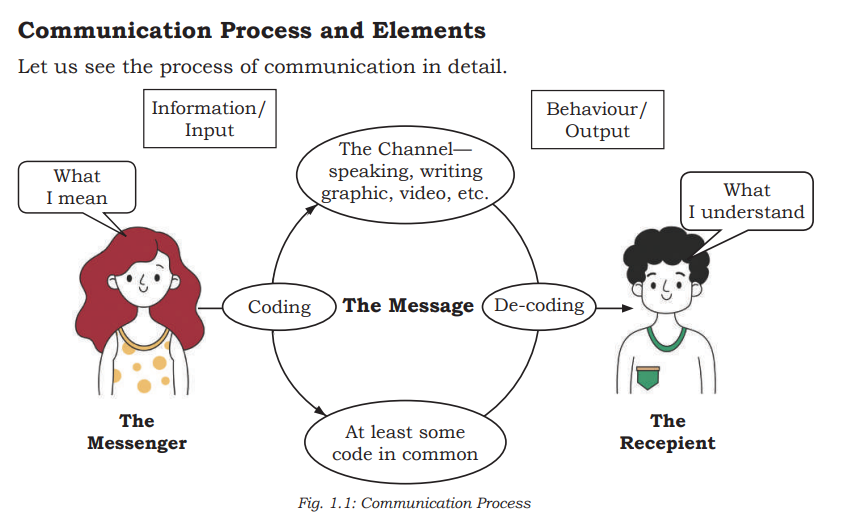
The Communication Cycle
In your CBSE exams, you might also be asked about the Communication Cycle, which involves these elements:
-
Sender: The person starting the communication.
-
Message: The information being sent.
-
Encoding: Converting the idea into a format (words/images).
-
Channel: The medium used (phone, email, air).
-
Receiver: The person who gets the message.
-
Decoding: Interpreting the message.
-
Feedback: The receiver’s response (crucial for “effective” communication).
Note: For a communication to be effective, it should follow the 7 Cs: Clear, Concise, Concrete, Correct, Coherent, Complete, and Courteous.
Q1. In communication theory, which component ensures effectiveness by closing the communication loop?
VR EDUCATIONS 🕉️ View Answer
✓ Correct: C – Feedback
📖 Explanation: Feedback completes the communication cycle by informing the sender whether the message was received and interpreted correctly. Without feedback, communication becomes one-way and ineffective. It allows correction of misunderstandings and ensures clarity, coherence, and completeness. In administrative communication and governance systems, feedback mechanisms are essential for accountability, evaluation, and policy adjustment. Thus, feedback is structurally necessary for effective communication.
Q2. Which form of communication primarily conveys emotions and attitudes rather than factual information?
VR EDUCATIONS 🕉️ View Answer
✓ Correct: B – Non-verbal communication
📖 Explanation: Non-verbal communication expresses emotions, attitudes, and intentions through body language, facial expressions, tone, and posture. Unlike verbal communication, which relies on words for meaning, non-verbal cues often reveal psychological states and interpersonal dynamics. It may reinforce, contradict, or substitute verbal messages. Studies in communication psychology suggest that emotional interpretation in face-to-face interaction depends largely on non-verbal signals rather than linguistic content.
Q3. A traffic signal conveying “stop” without words is an example of:
VR EDUCATIONS 🕉️ View Answer
✓ Correct: C – Visual communication
📖 Explanation: Visual communication transmits meaning through symbols, colors, images, and graphical representations. A traffic signal communicates instructions instantly without language dependence. The human brain processes visual information rapidly, enabling quick decision-making. Such communication is universal and efficient in high-speed environments like transportation systems. Therefore, symbolic representation using images or color coding constitutes visual communication.
Q4. Para-language refers to:
VR EDUCATIONS 🕉️ View Answer
✓ Correct: B – Tone, pitch and voice modulation
📖 Explanation: Para-language includes vocal elements accompanying speech such as tone, pitch, volume, speed, and stress. It modifies meaning without altering words. The same sentence can express anger, doubt, or enthusiasm depending on vocal delivery. Para-language is categorized under non-verbal communication because meaning is conveyed beyond linguistic content. It is essential for emotional interpretation and interpersonal communication effectiveness.
Q5. Which communication method provides permanent documentation and legal validity?
VR EDUCATIONS 🕉️ View Answer
✓ Correct: B – Written communication
📖 Explanation: Written communication produces permanent records that can be stored, referenced, and legally verified. Documents such as reports, notices, agreements, and official correspondence create accountability and traceability. Unlike oral communication, written forms reduce ambiguity through documentation. In governance and administration, written communication ensures transparency, evidence-based decision-making, and institutional memory. Hence it is preferred for formal and legal purposes.
Q6. Proximity in communication primarily indicates:
VR EDUCATIONS 🕉️ View Answer
✓ Correct: A – Physical distance between communicators
📖 Explanation: Proximity refers to spatial distance maintained during interaction. It communicates power relations, intimacy, formality, and cultural norms. Close distance may indicate familiarity or authority, while greater distance reflects formality or respect. Anthropological communication studies treat proximity as a key non-verbal signal influencing perception, comfort level, and interpersonal dynamics in social and organizational settings.
Q7. Encoding in communication cycle means:
VR EDUCATIONS 🕉️ View Answer
✓ Correct: C – Converting idea into communicable form
📖 Explanation: Encoding is the cognitive process of transforming thoughts into symbols, words, gestures, or images that can be transmitted through a channel. It precedes message transmission and determines clarity and coherence. Ineffective encoding leads to ambiguity and misunderstanding. Therefore, encoding is foundational to communication accuracy and effectiveness.
Q8. Which method is most suitable for quick comprehension of complex data?
VR EDUCATIONS 🕉️ View Answer
✓ Correct: C – Visual communication
📖 Explanation: Visual communication simplifies complex information using charts, graphs, diagrams, and maps. Cognitive research shows visual processing occurs faster than textual comprehension. Patterns, trends, and relationships become immediately perceptible. This method reduces cognitive load and enhances retention. Therefore, visual representation is most efficient for communicating complex datasets and statistical information.
Q9. Noise in communication refers to:
VR EDUCATIONS 🕉️ View Answer
✓ Correct: B – Any distortion affecting message clarity
📖 Explanation: Noise represents any interference that disrupts transmission or interpretation of a message. It includes physical noise, semantic confusion, psychological bias, or technological disturbance. Noise reduces communication effectiveness by distorting meaning. Communication models treat noise as a universal barrier affecting encoding, transmission, and decoding processes. Managing noise is essential for clarity and accuracy.
Q10. Eye contact primarily signifies:
VR EDUCATIONS 🕉️ View Answer
✓ Correct: B – Interest and confidence
📖 Explanation: Eye contact is a significant non-verbal cue indicating attention, sincerity, confidence, and engagement. It regulates conversational flow and establishes interpersonal trust. Excessive or insufficient eye contact may communicate dominance, anxiety, or disinterest. Thus, eye contact functions as an essential regulator of interpersonal communication effectiveness.
Q11. Which of the following best represents a communication channel?
VR EDUCATIONS 🕉️ View Answer
✓ Correct: B – Medium of transmission
📖 Explanation: A channel is the medium through which a message travels from sender to receiver. It may be oral, written, digital, or visual. Channel selection influences clarity, speed, reach, and interpretation. In organizational communication, choosing the appropriate channel determines effectiveness and efficiency of information transfer.
Q12. Which of the following is NOT among the 7 Cs of communication?
VR EDUCATIONS 🕉️ View Answer
✓ Correct: D – Creative
📖 Explanation: The 7 Cs of communication are Clear, Concise, Concrete, Correct, Coherent, Complete, and Courteous. These principles ensure precision, accuracy, and effectiveness. Creativity may enhance communication but is not a formal structural requirement in the 7 Cs framework.
Q13. Decoding refers to interpretation by:
VR EDUCATIONS 🕉️ View Answer
✓ Correct: B – Receiver
📖 Explanation: Decoding is the cognitive process through which the receiver interprets the encoded message. Meaning depends on knowledge, perception, and context. Misinterpretation during decoding leads to communication failure.
Q14. Facial expressions primarily belong to:
VR EDUCATIONS 🕉️ View Answer
✓ Correct: C – Non-verbal communication
📖 Explanation: Facial expressions convey emotional states instantly without words. They are universal communicative signals influencing interpretation of verbal content and interpersonal perception.
Q15. Which communication type is most structured and formal?
VR EDUCATIONS 🕉️ View Answer
✓ Correct: B – Written official communication
📖 Explanation: Written official communication follows standardized formats, legal protocols, and institutional norms. It ensures precision, accountability, and permanence in formal systems.
Q16. Communication through maps and diagrams is:
VR EDUCATIONS 🕉️ View Answer
✓ Correct: C – Visual
📖 Explanation: Visual communication uses graphical representation to convey spatial and quantitative information effectively and quickly.
Q17. Which element initiates communication?
VR EDUCATIONS 🕉️ View Answer
✓ Correct: B – Sender
📖 Explanation: The sender originates the message by conceptualizing and encoding information for transmission through a selected channel.
Q18. Which communication method is fastest for interpersonal clarification?
VR EDUCATIONS 🕉️ View Answer
✓ Correct: C – Oral
📖 Explanation: Oral communication allows immediate feedback, clarification, and dynamic interaction, making it fastest for resolving doubts.
Q19. Which method is least dependent on language literacy?
VR EDUCATIONS 🕉️ View Answer
✓ Correct: C – Visual
📖 Explanation: Visual communication uses images and symbols that can be understood universally regardless of language proficiency.
Q20. Effective communication primarily depends on:
VR EDUCATIONS 🕉️ View Answer
✓ Correct: C – Mutual understanding
📖 Explanation: Communication becomes effective only when sender and receiver share common understanding of meaning. Transmission alone does not guarantee effectiveness. Mutual interpretation ensures clarity, coherence, and completeness.


Share this content: