Maintain Healthy, Safe and Secure Working Environment

 0
0
 0
0
Maintain Healthy, Safe and Secure Working Environment
swaminarayan gurukul jadcherla ,NCERT
-
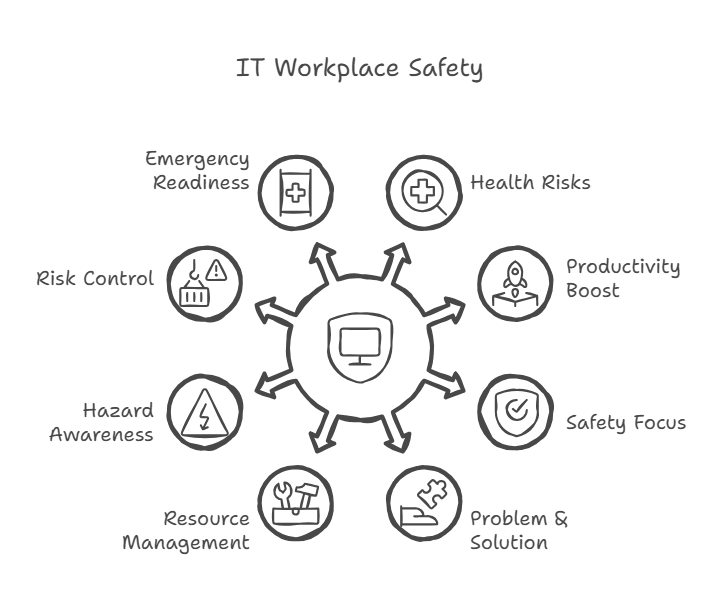
💻 Unique Work Culture: The IT industry differs from routine office jobs, often involving non-fixed working hours.
-
👁️ Health Risks: prolonged work in front of computers can lead to health issues, specifically eye strain.
-
🚀 Boost Productivity: Adopting safe work practices is essential to increase overall productivity.
-
🛡️ Safety Focus: This unit centers on maintaining a safe and secure working environment within the IT sector.
-
🏥 Problem & Solution: It identifies health problems caused by incorrect practices and provides their solutions.
-
⚙️ Resource Management: It covers the necessary resources required for a smooth and efficient workflow.
-
⚡ Hazard Awareness: Explains how to handle computer components safely and deal with electrical hazards.
-
⚠️ Risk Control: detailed workplace safety guidelines and methods to control various hazards.
-
🚑 Emergency Readiness: Illustrates how to handle medical emergency situations effectively.
Maintain Healthy, Safe and Secure Working Environment
Introduction One evening we were travelling on the busy road of Mumbai city. We were looking at the big and tall buildings. My friend was telling me that all these buildings hold different IT companies. Suddenly we find that there was a lot of smoke coming out of one building. People working in that building were running away from the building and shouting about the fire. Soon we find that the fire alarm was ringing and f ire brigade vehicles along with water tanks were approaching the building. People were telling that there are lot of casualties and the overall damage to the building was worth of several lakhs. This event reminds us the importance of health and safety at the workplace.
Every workplace accident, illness or dispute is a cost to organization, as well as a cost to injured individuals
and their families. It is our responsibility to create a safe workplace. This will improve the work environment and the productivity. Employees have to take responsibility for their own health and safety rather than relying solely on the “safety officer” or management.
Q1. Where were the narrator and his friend travelling?
🔍 View Answer & Explanation
✓ Correct: B – On a busy road in Mumbai
📚 Explanation: The passage clearly mentions travelling on a busy road in Mumbai city.
Q2. What kind of companies were located in the tall buildings?
🔍 View Answer & Explanation
✓ Correct: C – IT companies
📚 Explanation: The narrator’s friend mentions that the buildings housed IT companies.
Q3. What unusual thing did the narrator notice?
🔍 View Answer & Explanation
✓ Correct: B – Smoke coming out of a building
📚 Explanation: Smoke indicated a fire accident inside the building.
Q4. How did the people in the building react?
🔍 View Answer & Explanation
✓ Correct: C – They ran out shouting about fire
📚 Explanation: The people rushed out due to fear of fire.
Q5. Which emergency service arrived at the scene?
🔍 View Answer & Explanation
✓ Correct: C – Fire brigade with water tanks
📚 Explanation: Fire brigade vehicles rushed to control the fire.
Q6. What was said about the damage to the building?
🔍 View Answer & Explanation
✓ Correct: B – Damage worth several lakhs
📚 Explanation: The passage states that the loss was worth several lakhs.
Q7. What lesson does this incident teach us?
🔍 View Answer & Explanation
✓ Correct: B – Importance of health and safety at workplace
📚 Explanation: The incident highlights workplace safety awareness.
Q8. Workplace accidents are a cost to whom?
🔍 View Answer & Explanation
✓ Correct: C – Organization, employees and families
📚 Explanation: Accidents affect all stakeholders involved.
Q9. A safe workplace helps to improve:
🔍 View Answer & Explanation
✓ Correct: B – Work environment and productivity
📚 Explanation: Safety creates a positive and productive workplace.
Q10. Who should take responsibility for health and safety?
🔍 View Answer & Explanation
✓ Correct: C – Employees themselves
📚 Explanation: Every employee must be responsible for their own safety.
Health
- Health of an employee is the state of the physical, mental and social well being. Every organisation must provide healthy and safety working environment for their employees at the workplace.
- Health of an employee must be in a good condition so that the employees of the organisation will not suffer from any diseases. Cleanliness at the workplace is mandatory.
- The work places must be cleaned in the morning before the people start working. If it is neat and clean then the people will feel happy to work in that environment.
- A proper air conditioning is mandatory to provide clean and cool air at workplace.
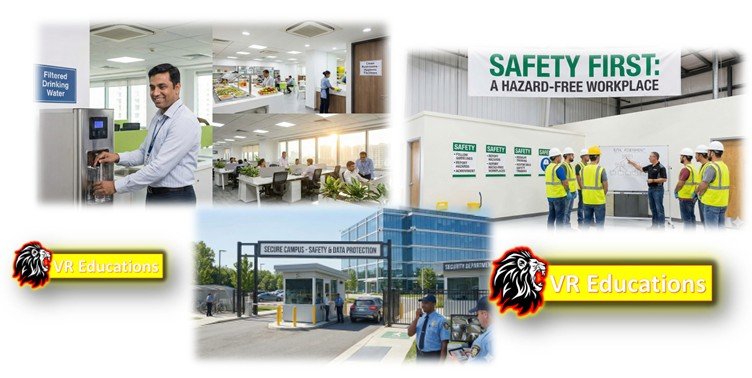
- A properly filtered water facility must be available for the employees of the company.
- A fresh food cafeteria must provide the good quality food for the employees. This will help to maintain the health of the employee. The organisation should maintain a clean washroom facility in good condition to be used by the employees.
Safety
- The work environment of the organisation must be safe.
- It must be free from hazards and risk. A hazard is the something that can cause harm to the people.
- A risk is a probability of causing harm to the people.
- A proper safety guidelines must be prepared by the company and it should be strictly followed. At regular intervals of time, the safety procedures must be practised by employees.
Security
- Every employee working in an organisation must feel that they are secured in the company campus. Security is a kind of freedom from any potential harm. Security ensures the safety of the people working in the organisation.
- Every organisation must have separate security department. This department should be responsible for various security such as personal safety, computer system safety, electrical safety, transport safety and other equipment safety.
- The proper security procedures will reduce liabilities, insurance and compensation for organisation. This will increase the business revenue and will reduce the operational charges of the company.
Q1. Health of an employee refers to which type of well-being?
🔍 View Answer & Explanation
✓ Correct: C – Physical, mental and social well-being
📚 Explanation: Health includes physical, mental and social well-being of employees.
Q2. Who is responsible for providing a healthy working environment?
🔍 View Answer & Explanation
✓ Correct: C – Organisation
📚 Explanation: Every organisation must provide a healthy and safe workplace.
Q3. Why is cleanliness at the workplace important?
🔍 View Answer & Explanation
✓ Correct: B – To avoid diseases
📚 Explanation: Clean workplaces help prevent diseases among employees.
Q4. When should the workplace be cleaned?
🔍 View Answer & Explanation
✓ Correct: C – Before employees start working
📚 Explanation: The workplace should be cleaned in the morning before work begins.
Q5. Which facility provides clean and cool air?
🔍 View Answer & Explanation
✓ Correct: B – Air conditioning
📚 Explanation: Proper air conditioning ensures clean and cool air at the workplace.
Q6. What type of water should be provided to employees?
🔍 View Answer & Explanation
✓ Correct: C – Filtered water
📚 Explanation: Filtered water helps maintain good health of employees.
Q7. What is a hazard?
🔍 View Answer & Explanation
✓ Correct: B – Something that can cause harm
📚 Explanation: A hazard is anything that can cause injury or damage.
Q8. What does risk mean?
🔍 View Answer & Explanation
✓ Correct: C – Probability of causing harm
📚 Explanation: Risk refers to the chance that harm may occur.
Q9. Why should safety procedures be practised regularly?
🔍 View Answer & Explanation
✓ Correct: C – To ensure employee safety
📚 Explanation: Regular practice helps employees respond safely during emergencies.
Q10. Why is a security department important in an organisation?
🔍 View Answer & Explanation
✓ Correct: B – To ensure safety and reduce losses
📚 Explanation: Proper security reduces risks, liabilities and operational costs.
Policies and Procedures for Health, Safety and Security
The Department of Information Technology(DoIT) has prepared the policy to provide employees with a healthy and safe work environment.
Definition
- A health, safety and security policy is a written statement by an employer stating the company’s commitment for the protection of the health, safety and security of employees and to the public. It is an endorsed commitment by management to its employees regarding their health, safety and security. A health, safety and security program/policy contains the health, safety and security elements of an organisation and objectives which make it possible for the company to achieve its goal in the protection of its workers at the workplace.
- The government has a specific section mentioned in their company laws, which states the minimum requirements to be followed for health, safety and security programme. Each employer or company should follow these requirements. Apart from that the company should also have their own health, safety and security committee to determine the hazards present at the workplace. Once these hazards are identified then their control measures should be specified in the health, safety and security programme.
Reasons for Health, Safety and Security Programs or Policies in Workplace
There are several reasons that can be specified for safety
policy as given below.
- It clearly indicates the company’s commitment for their employee’s health and safety;
- It shows the performance of the business and the safety performance are compatible with each other;
- It clearly state that the company is not only doing the business for profits but it is taking care of all its stake holders. The accountability of every one working for the company is outlined for the workplace health, safety and security;
- Company can comply national policy on Occupational Health and Safety (OH&S) of Government of India;
- Injuries and illness of the employees is prevented through such policy
A typical policy of an IT company may contain the following OH&S clauses.
- Provide adequate resources to ensure continual improvement in its OH&S performance.
- Comply with relevant OH&S legal and other requirements applicable to the organisation and drive for ‘beyond compliance’ leadership.
- Set appropriate OH&S objectives & targets and conduct periodic performance reviews against these targets.
- Adopt measures and processes that focus on the prevention of occupation related accidents, injuries, illnesses, and near-misses and strive to
continuously improve such processes.
- Ensure OH&S awareness and build competency associated at all levels to handle individual OH&S responsibilities.
Workplace Safety Hazards
- The most common definition of hazard is ‘a danger or risk’ that is associated with something. Something can even be considered a hazard if it would be a trigger for causing another hazard to become present, which could hurt someone or something in the area. Workplace hazards poses potential harm to people at work, and that can cause damage to the work environment and everything else in it. Hazards could cause adverse health effects and losses of property and equipment for organisations.
- There is a common way to classify hazards, and not all these are present in all workplaces. In some industries like manufacturing and pharmaceuticals, there are biological and chemical risks that pose risks to the workers. Physical hazards are present as well in many industries where there is exposure to electricity, radiation, extreme pressures, noises and magnetic fields. On the other hand, ergonomic hazards are present in facilities where there are repetitive movements and where workstations are set up haphazardly.
- But it can be generalized that in all these classifications, there are always safety hazards that come up along with the highlighted workplace hazards.
Physical Hazards
- It is the risks arising from the physical work environment – floors, facilities, walls, and ceilings. Physical hazards could also mean working with machinery and electricity operated machines. Work processes or specific assignments could also qualify as areas where physical hazards are present. There is a vast list of physical hazards across all industries, but when we look at one specific sector, these hazards are also specific to the work setting.
Falling Off Heights, Slipping and Tripping
- The reasons for falling are attributed to faulty scaffolding and ladders, as a result of contact with electricity, and slipping or crashing into anything that throws the worker off balance. On the other hand, trips and slips occur right on lower levels, particularly the floor, on ramps and any uneven surface in the workplace.
- Various injuries result from simply tripping over things at work, while many more accidents occur when employees slip on the floor, from
- motorized vehicles or from scaffolding or ladders.
- To avoid falls and slips, all things must be arranged properly. Any spilt liquid, food or other items such as paints must be immediately cleaned to avoid any accidents. Make sure there is proper lighting and all : Falling off height, slipping and tripping damaged equipment, stairways and light fixtures are repaired immediately.
Electrical Hazards
- There are many reasons why workers get electrocuted or suffer from electric shock at work. For the most part, it’s due to coming in direct contact with live wires, or having indirect contact through a conductor. While not all electrical accidents lead to death, there are many life-threatening, severe and often permanent injuries that could result from it. At work, the common causes of electrical accidents are exposed, worn-out wiring, overloading of electrical outlets, ungrounded or faulty equipment, and unsafe use of electrical equipment.
- Employees must be provided basic knowledge of using electrical equipment and common problems. Employees must also be provided instructions about electrical safety, such as keeping water and food items away from electrical equipment. Electrical technician and engineers should carry out routine inspections of all wiring to make sure there are no damaged or broken wires.
Fire Hazards
Each establishment must comply with housekeeping standards to ensure fire safety. Everyone not follows such requirements, and this leads to accidents resulting to fire. Such incidents not only damage the vital workplace equipment, stock and other items, and the building; it could also lead to injuries among its employees. To avoid fire, it is important to observe safety precautions at workplace. The whole organisation must also have first response and emergency mitigation systems in place. Employees should be aware of all emergency exits, including fire escape routes, of the office building and also the locations of fire extinguishers and alarms.
Health Hazards
- Health refers to the physical well-being of the workers,and this includes the condition of their skin, eyes, ears and all other body parts. But it also includes the health situation of what we cannot see upfront – their respiratory and cardiovascular system, and the nervous system.
- Hazards are present in most workplaces that could impact any part of the human body. For example, a noisy machine or factory environment could damage the sense of hearing of the workers. In the same manner,exposure to bright lights and toxic fumes and vapour could damage the eyes and nose. There are also moreserious and long-term health issues arising from hazardous workplaces, such as damage to the lungs because of the exposure to harmful chemicals.
potentIal SourceS of HazardS In an organISatIon
Bright light sources behind the display screen can create contrast problems, making it difficult to clearly
see your work. Apply the following possible solutions to avoid this.
- Use blinds or drapes on windows to eliminate bright light. Blinds and furniture placement should be adjusted to allow light into the room,but not directly into your field of view.
- Use indirect or shielded lighting where possible and avoid intense or uneven lighting in your field of vision. Ensure that lamps have glare shields or shades to direct light away from your line of sight.
- Reorient the workstation so bright lights from open windows are at right angles with the computer screen.
- High contrast between light and dark areas of the computer screen, horizontal work surface, and surrounding areas can cause eye fatigue and headaches. So, use well-distributed diffuse light.
Hazards using Computers
Hazards while using computers include poor sitting postures or excessive duration of sitting in one position. These hazards may result in pain and strain. Making the same movement repetitively can also cause muscle fatigue. In addition, glare from the computer screen can be harmful to the eyes. Stretching at regular intervals or doing some simple yoga in your seat can mitigate such hazards.
Handling Office Equipment
Improper handling of office equipment can result in injuries. For example, sharp-edged equipment if not handled properly, can cause cuts. Staff members should be trained to handle equipment properly. A relevant manual should be made available by the administration on handling equipment.
Handling Objects
Lifting or moving heavy items without proper procedure or techniques can be a source of potential hazard. Always follow approved procedure and proper posture for lifting or moving objects.
Stress at Work
In organisations, you may encounter various stress causing hazards. Long working hours can be stressful and so can aggressive conflicts or arguments with colleagues. Always look for ways for conflict resolution with colleagues. Have some relaxing hobbies for stress against long working hours.
Working Environment
Potential hazards may include poor ventilation, chairs and tables of inappropriate height, hard furniture, poor lighting, staff unaware of emergency procedures, or poor housekeeping. Hazards may also include physical or emotional intimidation, such as bullying or ganging up against someone. The staff should be made aware of organisation’s policies to fight against all the given hazards related to a working environment.
Hazard Control
Hazards that have been identified and assessed as priorities require to implement adequate control measures. Control measures should follow the hierarchy with a strong emphasis on eliminating hazards at the source, whenever possible.
- Take all feasible measures to eliminate the hazard, for example, by substituting or modifying the process.
- If elimination is impractical or remains incomplete, take all feasible measures to isolate the hazard, for example, instituting engineering controls such as insulating noise.
- If it is totally impossible to eliminate or isolate the hazard, its likelihood to cause injury should be minimised. Ensure that effective control measures are being applied, such as installing proper exhaust ventilation and providing personal protective clothing and equipment that is properly used and maintained, and monitoring exposure among at-risk workers
Safety Guidelines Checklist
- Store all cleaning chemicals in tightly closed containers in separate cupboards.
- Throw garbage daily.
- Make sure all areas have proper lighting.
- Do not wear loose clothing or jewellery when working with machines.
- Never distract the attention of people who are working near a fire or with some machinery, tools or equipment.
- Where required, wear protective items, such as goggles, safety glasses, masks, gloves, and hair nets.
- Shut down all machines before leaving for the workplace.
- Do not play with electrical controls or switches.
- Do not operate machines or equipment until you have been properly trained and allowed to do so by your supervisor.
- Repair torn wires or broken plugs before using any electrical equipment.
- Do not use equipment if it smokes, sparks or looks unsafe.
- Cover all food with a lid, plastic wrap or aluminium foil.
- Do not smoke in ‘No Smoking’ areas.
- Report any unsafe condition or acts to your supervisor.
Class 10


Share this content: